How Agencies Can Streamline Shift Requests Beyond Phone and Email
Forward-thinking agencies replace phone and email for shift requests with dedicated software, improving communication, fill rates, and operational visibility across their temporary staffing workflows.
usman ahmed

Key takeaway
Adopting dedicated temporary staffing software allows agencies to centralise client shift requests, improving accuracy, speeding up worker placements, and providing a clear audit trail for compliance and payroll.
Many temporary staffing agencies still rely on a mix of phone calls, emails, and messaging apps to manage client shift requests. While these methods are familiar, they often lead to inefficiencies, missed details, and duplicated effort. For an agency dealing with fluctuating demand and multiple clients, fragmented communication can impact fill rates and internal operational visibility. This article explores how agencies replace phone and email with more structured, integrated solutions, enabling faster response times and better coordination for temporary staffing needs.
Why Agencies Replace Phone and Email for Shift Requests
The traditional reliance on phone and email for shift requests introduces several operational challenges for agencies. A recruitment desk might be fielding a dozen calls and hundreds of emails daily, each requiring manual entry of shift details, worker requirements, and client information. This chaotic approach creates a bottleneck, especially during peak hours. Details can be miscommunicated, leading to incorrect shift bookings, worker no-shows, or compliance oversights. Furthermore, tracking the history of a request, including amendments or cancellations, becomes a complex task spread across various inboxes and call logs, making auditing difficult and increasing potential for disputes. Moving beyond these methods offers a path to greater efficiency and accuracy in managing temporary worker placements.
Common Operational Hurdles with Traditional Methods
Operating temporary staffing with phone and email encounters predictable pain points daily. Consider these scenarios:
- Late Client Cancellations: A client calls to cancel a shift just hours before it's due to start. If the message isn't picked up immediately, the agency may still send a worker, leading to wasted travel time and a frustrated worker. Tracking that cancellation and ensuring the worker isn't paid unnecessarily, while also informing other departments, relies on manual communication ensuring every team member is updated.
- Complex Shift Requirements: A client emails with a detailed breakdown of 10 different roles, each with varying start times, skill sets, and compliance needs. Manually parsing this email, extracting information, and translating it into individual shift offers is time-consuming and prone to errors. Attachments containing specific job descriptions or site maps can also be overlooked.
- Timesheet Discrepancies: A worker submits a timesheet that doesn't match the client's records, potentially due to a verbal agreement made during a phone call that was never formally logged. Resolving these disputes requires trawling through emails or attempting to recall phone conversations, impacting payroll preparation and client relationships. Without a clear audit trail, establishing the truth becomes challenging.
Streamlining Shift Request Capture with Employer Portals
One of the most effective ways for agencies to move beyond fragmented communication is by providing clients with a dedicated employer portal. This dedicated platform allows employers to submit shift requests directly into your agency's system. Clients can input all necessary details – shift dates, times, roles, required skills, location, and even specific notes – through a structured form. This immediately centralises information, reducing data entry errors and ensuring all critical compliance information is captured upfront. The portal provides a consistent, transparent channel for communication, offering clients clear visibility into the status of their requests and confirmed bookings. This structured intake process feeds directly into your internal systems, making it easier for your recruitment desk to manage current and upcoming demand.
Improving Fill Rates Through Integrated Workflow
Once a shift request is captured digitally, an integrated system can dramatically improve fill rates. Instead of manually sifting through worker pools or sending out individual messages, a platform can automatically match available and compliant workers to open shifts based on criteria such as skills, certifications, and availability. For agencies, this means faster processing of requests and quicker placements. When an agency uses tools for shift matching, they can send out targeted shift offers to suitable candidates via their worker portal. Workers can then accept or decline shifts directly, updating their availability instantly. This reduces the administrative overhead associated with chasing workers via phone or email, which is critical for time-sensitive roles and maintaining high client satisfaction.
Enhancing Operational Visibility and Audit Trails
Moving beyond phone and email centralises all shift-related communications and data, creating a comprehensive audit trail. Every action – a client's request, a worker accepting a shift, an approved timesheet – is logged within the system. This provides enhanced operational visibility for the entire agency. Directors can view real-time fill rates, recruitment desks can quickly see outstanding requests, and compliance teams can verify that all necessary right-to-work checks and certifications are linked to specific placements. This level of transparency is invaluable for dispute resolution, compliance reporting, and overall business intelligence. It helps agencies proactively address potential issues before they impact service delivery or lead to financial losses.
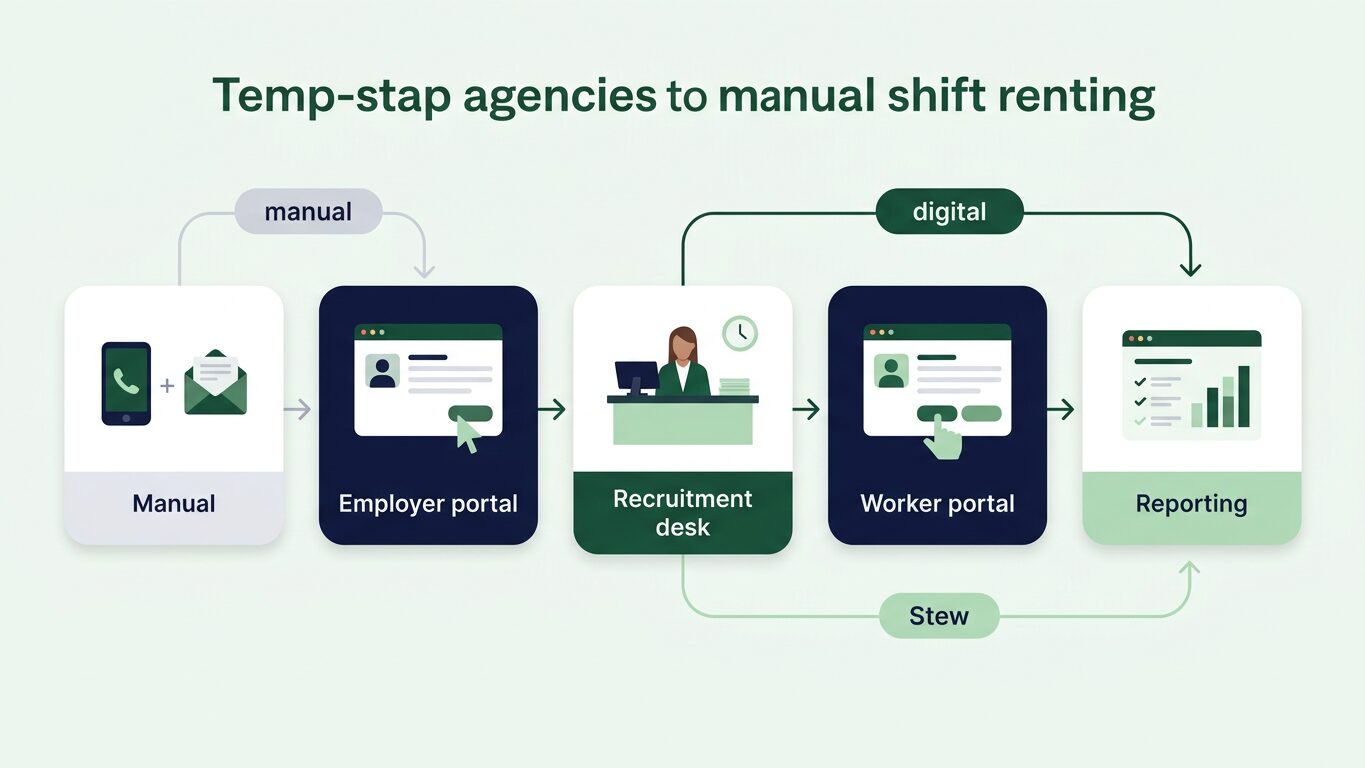
Transitioning from fragmented phone and email requests to a structured digital workflow streamlines agency operations.
Practical Checklist for Agencies Replacing Phone and Email
Migrating from traditional communication methods to a more integrated system requires careful planning. Agencies looking to streamline their shift request process should consider the following steps:
- Evaluate Current Workflow: Map out how shift requests are currently handled from client contact to worker placement and payroll preparation.
- Identify Bottlenecks: Pinpoint specific areas where phone and email create delays, errors, or excessive manual work.
- Research Software Options: Look for temporary staffing platforms designed specifically for your industry that offer employer portals and shift management features.
- Phased Implementation: Start with a pilot group of clients or a specific division to test the new system and gather feedback.
- Client Communication: Clearly communicate the benefits of the new portal to clients, explaining how it will improve their experience.
- Staff Training: Ensure your recruitment desk and administrative teams are fully trained on the new platform.
- Monitor and Adjust: Regularly review usage data and feedback to make ongoing improvements to your process and system configuration.
Embracing technology to manage shift requests allows temporary staffing agencies to operate more efficiently, improve client and worker satisfaction, and maintain better control over their operations. It shifts the focus from reactive communication to proactive management, giving your team more time to focus on strategic initiatives rather than administrative burdens.
Ready to see how Youtemp can help your agency streamline its shift request processes and improve operational efficiency? Join our waitlist for early access and discover a new way to manage your temporary staffing operations.
Ready to Modernise Your Agency's Shift Requests?
Discover how Youtemp can help your agency move beyond the complexities of phone and email, centralising client requests and optimising your temporary staffing operations.