Streamlining Responses When Clients Request Temporary Staff
Agencies often face pressure to quickly fulfil requests when clients request temporary staff, requiring efficient processes for shift matching, worker availability, and clear communication to maintain good fill rates.
usman ahmed

Key takeaway
Efficiently handling client requests for temporary staff requires integrated systems for real-time availability, compliance tracking, and transparent communication to minimise delays and maximise fill rates.
When temporary staffing agencies receive a request for temporary staff from a client, the speed and accuracy of the response directly impact fill rates and client satisfaction. Delays in this crucial phase can lead to lost opportunities, frustrated clients, and increased operational costs. Effective systems for handling these requests are not just about finding a worker; they involve a coordinated effort covering worker availability, compliance, and clear communication streams. The objective is to move from a client's initial need to a confirmed worker on site as efficiently as possible, managing all the moving parts that make temporary staffing work.
Understanding the Client's Initial Request
The process begins with the client's request. This can come in various forms: an email, a phone call, or a submission through a client portal. For agencies, understanding the exact nature of the requirement is paramount. This includes key details like:
- Role and responsibilities: What tasks will the worker perform?
- Required skills and experience: Are specific qualifications or certifications needed?
- Shift patterns and duration: Dates, times, estimated length of engagement.
- Location: Where will the work be performed?
- Pay rate: Agreed daily or hourly rate, considering AWR implications and minimum wage requirements.
Collecting this information accurately at the outset prevents misunderstandings and reduces the need for back-and-forth clarification. A structured intake process, ideally through an employer portal, ensures all necessary data points are captured consistently from the start.
Optimising Worker Matching and Availability
Once the agency has a clear understanding of the client's needs, the next step is to identify suitable temporary workers. This is often the bottleneck in the process. Traditional methods involving sifting through spreadsheets or making numerous phone calls to check availability can be slow and inefficient.
Modern platforms allow agencies to:
- Access real-time availability: Workers update their availability directly through a worker portal, giving agencies an immediate overview of who is free.
- Filter by skills and qualifications: Quickly narrow down the pool of available workers based on the client's specific requirements.
- Automate shift offers: Send out shift details to a targeted group of workers who meet the criteria and are available, allowing them to accept or decline electronically.
This streamlines the shift matching process, significantly cutting down the time it takes to present suitable candidates to clients. When clients request temporary staff, they expect agencies to have immediate insight into who can do the job and when.
Ensuring Compliance and Right to Work
Before a temporary worker can be placed, their compliance documents must be in order. This includes right-to-work checks, professional certifications, DBS checks (where applicable for specific roles), and signed contracts. Delays here can jeopardise a placement, even if the perfect worker has been found.
Agencies need a robust system that:
- Tracks expiry dates for documents.
- Flags missing or incomplete compliance items.
- Allows workers to upload and update their documents securely through a worker portal.
Having all compliance data digitised and accessible means agencies can quickly verify a worker's eligibility and reduce the administrative burden of preparing them for a shift. This proactive approach ensures that when a client's request comes in, the pool of potential staff is already largely compliant.
Communication and Feedback Loops
Clear and timely communication with both clients and workers is essential for managing expectations and resolving issues. Keeping the client informed about the progress of their request, from worker identification to confirmation, builds trust. Similarly, transparent communication with workers about shift details, changes, and feedback helps prevent no-shows and ensures a smooth engagement.
Consider:
- Automated notifications: Updates sent to clients when a worker is confirmed or if there are any issues.
- Dedicated portals: Centralised places for workers to view schedules and for clients to monitor booked staff.
- Feedback mechanisms: Simple ways for clients to provide feedback on worker performance, which can inform future placements.
Practical Staffing Scenarios When Clients Request Temporary Staff
Agencies frequently encounter varied scenarios when dealing with client requests. Here are a few common operational examples:
Scenario 1: Urgent Same-Day Request A care home client calls at 7 AM requiring a healthcare assistant for a shift starting at 8 AM due to a last-minute sickness. An agency using a manual system might spend an hour calling available workers, potentially missing the window. With real-time availability and automated shift offers, the agency can immediately identify qualified, available staff, send out an instant offer, and get a quick acceptance.
Scenario 2: Shift Cancellation by Worker A warehouse client requests 10 temporary warehouse operatives for a weekend. The agency confirms all 10, but one worker cancels late on Friday afternoon. A manual process would involve frantic calls. A system that shows immediate alternative availability and allows for rapid re-offers minimises disruption for the client and prevents a gap in coverage.
Scenario 3: Client Changes Scope A logistics client requests 5 drivers for a specific route. After confirmation, the client updates the requirement to include a different vehicle license. Instead of re-starting the entire search, the agency can quickly filter their existing pool for workers with the updated qualifications, often through their operational tools that manage worker profiles and licenses.
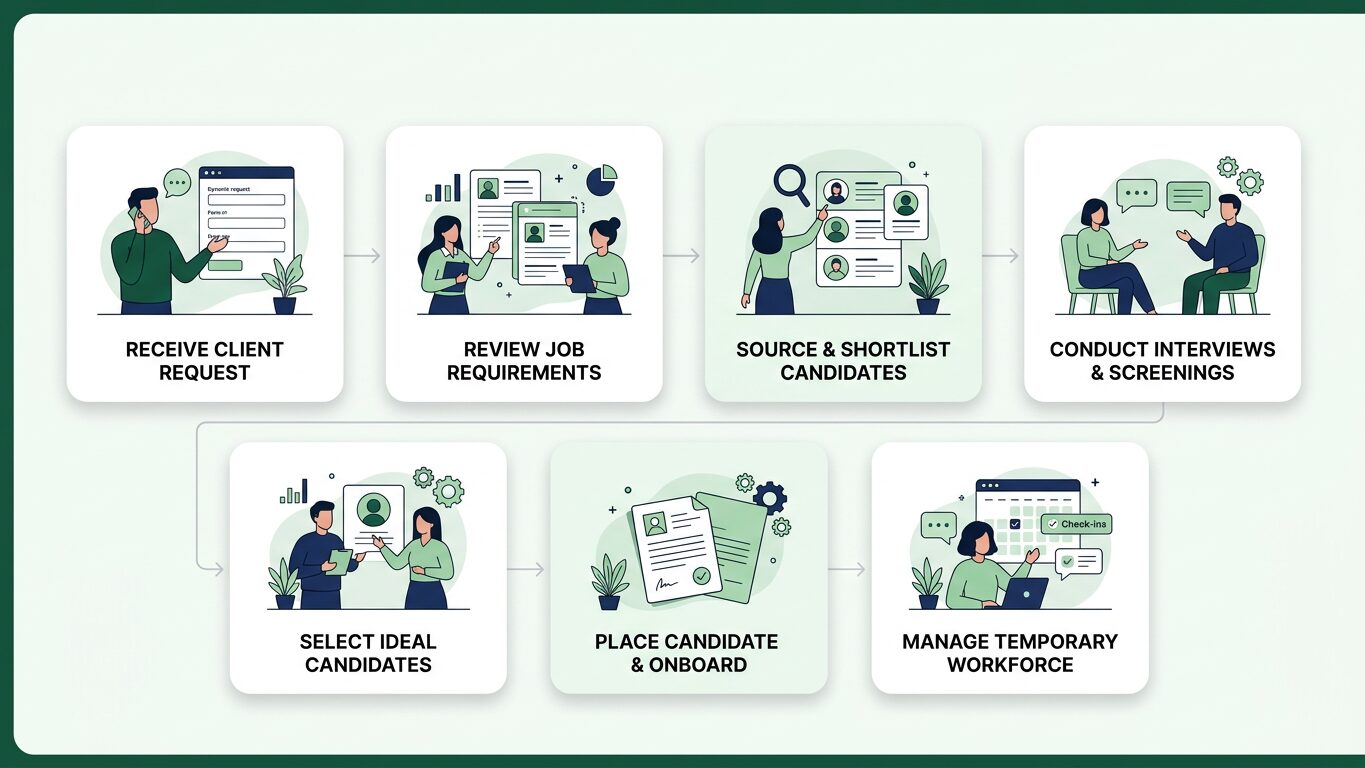
An efficient workflow helps agencies respond quickly when clients request temporary staff.
Checklist for Efficient Request Handling
To ensure your agency can respond efficiently when clients request temporary staff, consider this checklist:
- Define clear client request intake procedures.
- Implement real-time worker availability tracking.
- Automate shift matching and offer processes.
- Maintain digitised and up-to-date worker compliance records.
- Establish clear communication protocols with clients and workers.
- Review and analyse fill rates and response times regularly.
- Provide client and worker portals for self-service functionality.
Efficiently managing client requests for temporary staff hinges on integrating seamless workflows with clear communication and robust data management. By optimising these areas, agencies can improve fill rates, enhance client satisfaction, and ensure smoother operational delivery on every placement.
Are you looking to streamline your agency's response when clients request temporary staff? Youtemp helps agencies coordinate shifts, worker availability, timesheets, and compliance from one connected workflow. Join our waitlist to see how we can help your operations. Join the Youtemp waitlist
Streamline Your Agency's Staffing Requests
Youtemp helps agencies respond faster and more effectively when clients need temporary staff. Join our waitlist to discover how our platform can transform your operations.