What Information Do Employers Need for Temporary Worker Requests?
When requesting temporary workers, employers should provide clear information regarding shift details, required skills, compliance needs, and approval processes to ensure efficient fulfilment and smooth operations.
usman ahmed
Updated 9 July 2026

Key takeaway
Detailed, specific information upfront for temporary worker requests directly improves fulfilment speed and worker suitability, reducing operational issues and administrative burden.
Effective temporary staffing relies on clear communication between employers and agencies. When an employer needs to cover shifts, the accuracy and completeness of the information they provide directly impacts how quickly and effectively an agency can fulfil that request. Misunderstandings or missing details can lead to delays, unsuitable workers, or operational disruptions. Outlining specific job requirements and operational context upfront helps recruitment agencies match the right temp workers to the role, ensuring the employer's needs are met efficiently. Therefore, clarity is paramount when requesting temporary workers from an agency.
Core Information for Requesting Temporary Workers
To ensure a successful placement, several pieces of core information are essential when submitting a request for temporary workers. This foundational data allows agencies to filter their worker pools effectively and offer relevant candidates. Starting with the basics ensures everyone is clear on the role.
- Job Title and Department: A clear job title helps set expectations for the type of work involved. Naming the department aids in understanding the team structure and reporting lines.
- Location of Work: Specify the full address where the temporary worker will be based. If the role involves travel between sites, detail the expected travel requirements.
- Start Date and Duration: Provide the exact start date and the anticipated duration of the assignment (e.g., one week, three months, ongoing). This helps workers assess suitability for their availability.
- Working Hours and Shift Patterns: Detail the daily hours, breaks, and any specific shift patterns (e.g., 9-5, night shifts, rotating patterns). Accurately reflecting these helps avoid discrepancies later.
- Key Responsibilities: Outline the main duties the temporary worker will be expected to perform. This helps match workers with appropriate skills and experience.
Essential Skills and Experience Requirements
Beyond basic job details, agencies need to understand the skills and experience level required for the temporary role. Providing specifics here helps to filter candidates and ensures the workers supplied can hit the ground running, reducing the need for extensive on-site training.
- Specific Skills: List any essential technical skills (e.g., operating specific machinery, software proficiency) or soft skills (e.g., customer service, teamwork) crucial for the role.
- Required Qualifications/Certifications: If certain qualifications or certifications (e.g., Forklift licence, specific healthcare registration) are mandatory for legal or operational reasons, state these clearly.
- Experience Level: Indicate the minimum level of experience needed (e.g., entry-level, 1-2 years, experienced). This guides agencies in selecting candidates.
- Induction/Training Provided: Briefly explain what kind of induction or training the temporary worker will receive. This helps manage worker expectations.
Operational Context and Compliance Needs
For temporary staffing, the operational context and specific compliance requirements are key to lawful and effective deployment. Agencies manage compliance for their workers, but employers must provide the necessary information for the agency to act accordingly. For example, knowing if a role involves working with vulnerable adults impacts the necessary types of background checks.
- On-site Supervision: Confirm who the temporary worker will report to and the level of supervision they will receive. This also aids in understanding the employer's operational structure.
- Equipment/Software Access: Detail any equipment, software licences, or system access the worker will need. This helps agencies verify worker proficiency and employers prepare for their arrival.
- Dress Code/PPE: Any specific dress code or personal protective equipment (PPE) requirements should be communicated. This is particularly important for roles in manufacturing, healthcare, or hospitality.
- Right-to-Work Checks: While the agency typically manages the right-to-work checks for the temporary worker, employers should be aware it affects engagement. The agency relies on accurate job details to ensure all legal obligations are met. See how Youtemp helps agencies manage worker compliance.
- Any AWR Considerations: If the assignment is likely to extend beyond 12 weeks, the Agency Workers Regulations (AWR) may become relevant. Employers should flag long-term roles so the agency can prepare. The agency will manage AWR responsibilities, but early notification is helpful.
Practical Staffing Examples
Consider these scenarios where detailed information proves critical when requesting temporary workers:
Late Weekend Shift Cover: An employer needs an experienced logistics operator for a late Friday night shift, starting in 4 hours, due to an unexpected staff absence. Simply requesting “logistics worker” is insufficient. The agency needs the specific operational hours (e.g., 22:00-06:00), required certifications (e.g., counterbalance forklift licence), and the immediate urgency. Without this detail, the agency might send a general warehouse operative who is not qualified for the specific machinery.
Specialised Healthcare Support: A care home needs a temporary healthcare assistant who is proficient in using specific patient handling equipment and has experience with dementia care. Just asking for a “healthcare assistant” would lead to an agency sending a worker who might need significant on-the-job training, potentially impacting patient safety and care quality. The request should specify the required experience and equipment familiarity.
Project-Based Administrative Role: A marketing department needs a temporary administrator for a 3-month project. The role requires advanced Excel skills for data analysis and experience with a specific CRM software. If these details aren't provided, an agency could supply a general administrator who lacks the required software proficiency, leading to project delays and rework. The employer, via an employer portal, could specify these nuances when submitting the request.
Financial and Administrative Details
Transparency regarding financial and administrative aspects streamlines the entire temporary staffing process from booking to payroll. Approvals and budget oversight are crucial for employers.
- Budget/Charge Rate Expectations: While agencies provide their charge rates, knowing the employer's budget helps manage expectations and identify suitable workers within financial constraints.
- Timesheet Approval Process: Clearly define who is authorised to approve timesheets and the preferred method (e.g., via an employer portal, email). This prevents delays in worker payments.
- Purchase Order (PO) Details: If PO numbers are required for invoicing, ensure these are provided with the initial request or as soon as booking is confirmed. This avoids administrative bottlenecks.
- Contact Person: Indicate the primary contact person for the agency regarding this temporary worker request, including their direct contact details.
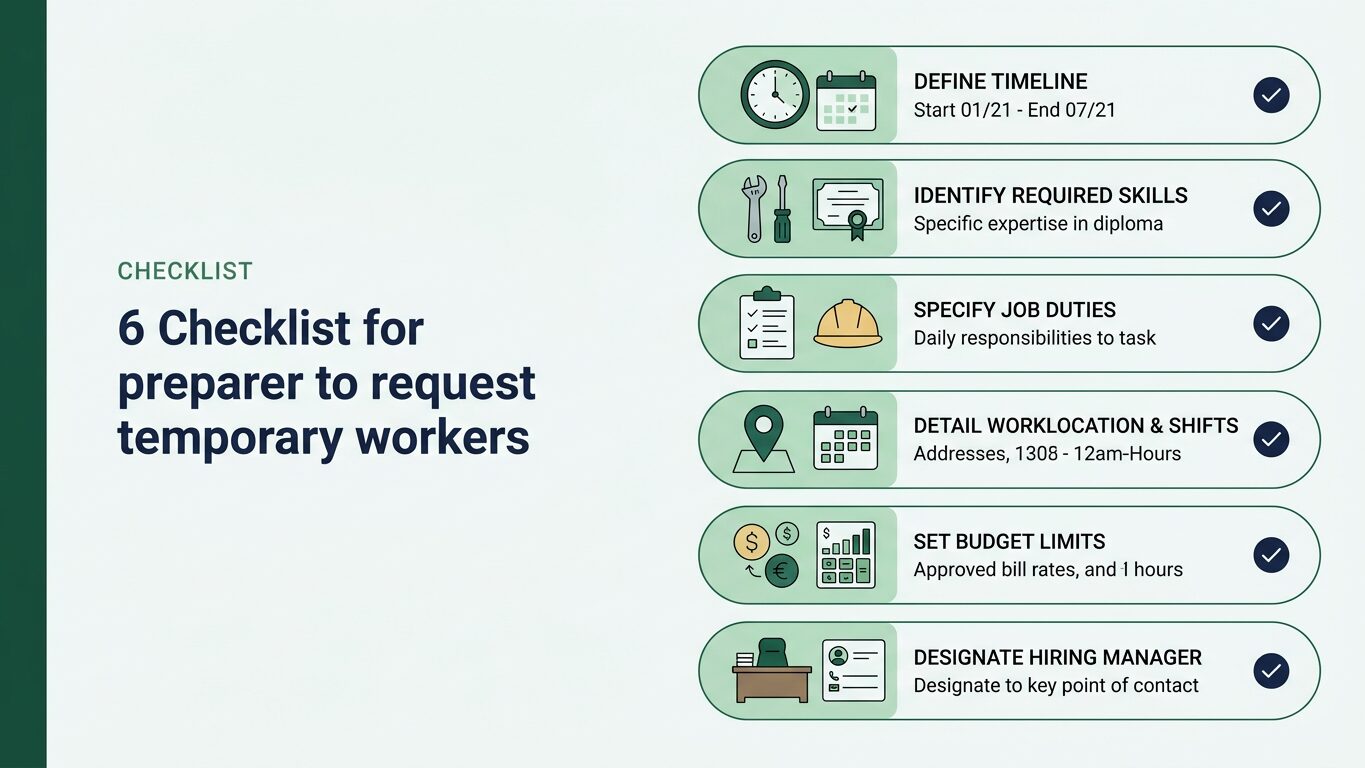
A checklist to guide employers in providing comprehensive information when requesting temporary workers.
Checklist for Requesting Temporary Workers
To ensure all vital information is covered, use this checklist when submitting your next temporary worker request:
- Job Details: Job title, department, work location, specific start/end dates, working hours/shifts.
- Skills & Experience: Key responsibilities, required technical skills, qualifications, experience level.
- Operational Specifics: On-site supervision, equipment needs, dress code/PPE, any AWR considerations.
- Compliance: Role's activities (e.g., working with vulnerable people to inform checks).
- Financial & Admin: Budget guidance, timesheet approver, PO details, main contact.
Providing comprehensive and accurate information when requesting temporary workers significantly improves the likelihood of a successful and efficient assignment. Clear communication from the outset reduces administrative overhead and ensures suitable workers are placed quickly.
To learn how Youtemp can help your organisation streamline submitting and managing temporary worker requests, join our waitlist for updates and early access.
Streamline Your Temporary Staffing Requests
Join the Youtemp waitlist to discover how our platform helps employers provide clear requests, manage approvals, and connect efficiently with agencies.