How Employers Submit Shift Requests Through a Staffing Portal
Understanding how employers submit shift requests through a dedicated staffing portal can streamline temporary hiring, improve shift management, and provide better visibility over worker bookings and budgets.
usman ahmed

Key takeaway
Using a dedicated staffing portal centralises shift requests, improves communication, and provides greater operational visibility for employers managing temporary staff.
For employers relying on temporary staff, the process for requesting workers can often involve multiple emails, phone calls, or even spreadsheets. However, modern staffing portals offer a more direct and efficient approach for how employers submit shift requests. These platforms are designed to centralise the communication, booking, and management of temporary staff, helping hirers maintain clear oversight from initial request to timesheet approval.
Moving away from fragmented communication methods allows for a more organised workflow. A dedicated employer portal integrates the request process directly into your wider temporary staffing operations, providing immediate updates and historical records. This operational clarity is crucial for managing fluctuating staffing needs effectively, particularly in sectors with high demand for shift-based workers.
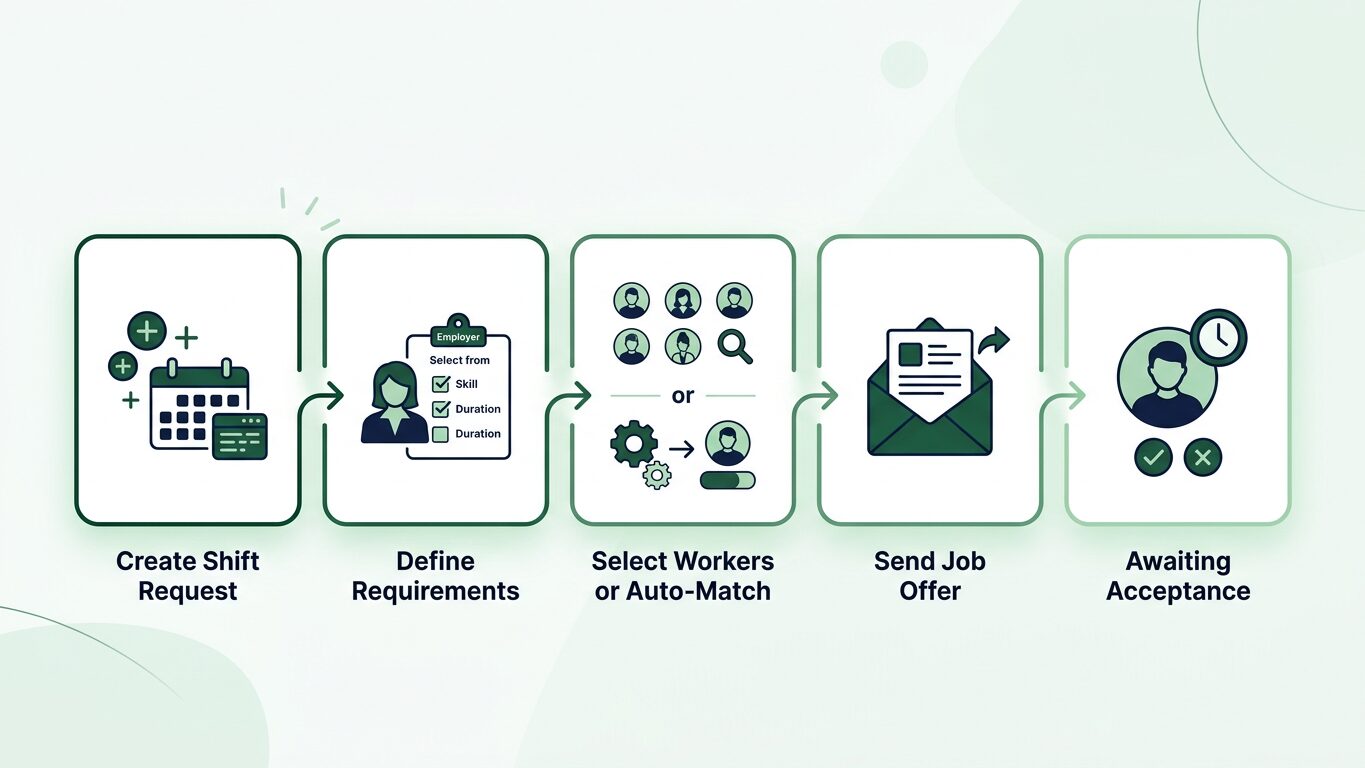
A simplified overview of the process for employers to submit and manage shift requests through a dedicated staffing portal.
Understanding the Employer Portal Workflow
A staffing portal provides a dedicated space for employers to manage all aspects of their temporary staffing needs. This typically begins with submitting a new shift request. The portal usually offers a clear, guided process, prompted by a template or form. Employers specify job roles, required skills, shift dates and times, duration, and any specific worker requirements. This structured approach ensures all necessary information is captured upfront, reducing back-and-forth communication.
Once a request is submitted, it moves through the agency's fulfilment process. Employers can often track the status of their requests in real-time, seeing which agency workers have been offered the shift, accepted it, or if further action is needed. This immediate visibility helps manage expectations and allows for quicker adjustments if, for example, a shift remains unfilled close to the start time.
Key Information for Submitting Effective Shift Requests
To ensure agencies can fulfil requests accurately and efficiently, employers need to provide comprehensive details. Beyond basic shift times and dates, crucial information includes:
- Job Role and Responsibilities: A precise description helps match the right worker skills. For example, a "Healthcare Assistant" might need to specify if patient moving and handling training is required.
- Required Skills and Qualifications: List any specific certifications, licences, or experience necessary. This is particularly vital for roles requiring specific compliance checks like DBS or professional registrations.
- Shift Location and Reporting Instructions: Clear addresses and who the worker reports to on arrival prevent delays.
- Expected Duration and Break Times: Helps workers understand the day's structure and ensures correct pay calculations.
- Pay Rate: Clearly stating the agreed hourly rate or daily fee simplifies budget tracking and worker expectations.
- Uniform/PPE Requirements: Any specific dress code or safety equipment needed.
- Special Instructions: Anything unique to the shift or workplace environment.
Providing this detail upfront reduces the likelihood of unsuitable worker placements or no-shows due to miscommunication. A well-structured shift request is foundational for efficient temporary worker fulfilment.
Practical Staffing Examples
Consider how a portal streamlines various scenarios:
- Late Cancellation: An employer in hospitality needs to reduce staff for a quieter Saturday evening shift. Instead of calling the agency and hoping to catch someone, they can log into the portal and adjust the shift request, notifying the agency immediately. The agency can then retract shift offers or inform booked workers, reducing potential costs or dissatisfaction.
- Urgent Requirement: A care home suddenly has a staff member call in sick for the night shift. Through the portal, the employer can quickly post an urgent request, flag it as high priority, and potentially see candidate profiles being offered the shift within minutes, aiding rapid fulfilment at https://youtemp.co.uk/employers/features/shift-management/.
- Recurring Shifts: For regular needs, such as a weekly cleaning shift, the employer can often use the portal to create recurring shift patterns. This saves time compared to submitting individual requests each week and helps build continuity with preferred workers.
These examples illustrate how a structured portal workflow helps employers respond to dynamic staffing situations more effectively, avoiding the delays common with traditional communication methods.
Approving Timesheets and Tracking Budgets
Beyond initial requests, the employer portal often extends to post-shift operations including timesheet approval and budget tracking. Once a shift is completed, workers can submit their timesheets directly through their own portal. Employers then receive a notification to review and approve these timesheets. This digital process reduces manual errors, speeds up payroll preparation for the agency, and provides a clear audit trail for both parties.
Furthermore, many portals include features for budget reporting. Employers can view real-time spend against various departments or projects, helping them stay within allocated budgets and manage their temporary staffing costs more transparently. This oversight is a significant advantage over managing invoices and worker hours via disparate systems.
Best Practices for Employer Portal Use
To maximise the benefits of a staffing portal when you initially employers submit shift requests and beyond, consider these practices:
- Train Your Team: Ensure everyone responsible for temporary hiring understands how to use the portal effectively, including submitting requests, reviewing workers, and approving timesheets.
- Be Specific in Requests: The more detail you provide about job roles, skills, and shift requirements, the better the match the agency can make.
- Utilise Feedback Mechanisms: If the portal offers rating or feedback tools for workers, use them to help agencies refine future placements and improve overall service quality. This contributes to better staff management long term.
- Review Regularly: Periodically check your active requests, pending approvals, and budget reports to stay on top of your temporary staffing operations.
- Communicate Clearly: Even with a portal, occasional direct communication with your agency contact is valuable, especially for complex or unusual requests.
Checklist for Effective Shift Request Submission
- Clearly define the job role and primary responsibilities.
- List all essential skills, qualifications, and certifications required.
- Specify exact shift dates, start/end times, and any break structure.
- Provide the precise location and reporting instructions for workers.
- Confirm the agreed pay rate or budget for the shift.
- Detail any specific uniform, PPE, or equipment needs.
- Note any specific compliance requirements, such as enhanced DBS checks for certain roles.
- Flag urgent shifts appropriately within the portal.
- Track the status of your requests and pending timesheet approvals.
Leveraging a dedicated portal for your temporary staffing needs significantly enhances operational visibility and control. By centralising your requests, you gain a more structured, auditable, and efficient way to secure the temporary workers your organisation requires. This approach helps reduce administrative burdens and allows you to focus on core operations.
If you're looking to streamline how your organisation handles temporary staffing requests, consider exploring Youtemp. Join our waitlist today to see how our employer portal can simplify your staffing process and provide better oversight. Join the Youtemp waitlist
Streamline Your Temporary Staffing Requests
Discover how the Youtemp employer portal can simplify your shift requests, worker management, and budget tracking. Join our waitlist to see it in action.