Agency Guide: Managing Temp Staff Across Multiple Locations
Effective management of temporary staff across diverse client sites requires clear systems for coordination, communication, and compliance to maintain service levels.
usman ahmed

Key takeaway
Centralising worker data and digitalising shift and timesheet workflows are critical for agencies to effectively manage temporary staff across multiple, disparate client locations while maintaining compliance and operational control.
Agencies face distinct challenges when coordinating temporary workers across a client's multiple locations. The fundamental issue isn't just distance; it's maintaining consistent operational control, ensuring compliance, and delivering timely shift fulfilment when your workforce and client sites are geographically spread. Without robust systems, agencies risk misplacing workers, missing compliance deadlines, or leaving shifts unfilled, directly impacting service quality and client relationships. This guide focuses on pragmatic strategies and tools to consolidate control and drive efficiency for agencies managing such complex, distributed temporary staffing operations.
Centralised Worker Pools and Availability
Central to effective multi-location management is a unified worker pool. When supporting multiple client sites, your agency needs one definitive source for all worker data: profiles, skills, compliance documentation (like right-to-work evidence), and up-to-date availability. Relying on fragmented spreadsheets or consultant-specific notes quickly becomes unsustainable and a source of error. A centralised system allows agencies to instantaneously filter for suitable temps, irrespective of which client location needs them.
For instance, if a client's care homes in Cardiff and Swansea both require night staff, your desk must quickly identify all available and qualified care workers within a reasonable commute for either location. This demands a system where workers can easily update their availability, and your team can view a consolidated pipeline of who is ready for shifts, backed by all necessary compliance checks. This streamlines the process of allocating the right person to the right shift, especially when a worker management module handles document expiry notifications and certifications centrally.
Streamlining Shift Fulfilment and Matching
Receiving numerous shift requests from various client locations necessitates an efficient fulfilment process. Manual allocation, relying on phone calls and emails, limits your agency's capacity to respond quickly, especially to urgent requirements or last-minute changes. A streamlined approach ensures that once a shift is requested, it can be matched with suitable workers in moments, not hours.
Effective shift matching considers more than just basic availability; it factors in worker skills, location, travel preferences, and specific client requirements or preferred worker groups. Automating this crucial step significantly improves fill rates and reduces the administrative burden on your recruitment consultants. For example, if a client needs a skilled forklift operator for their depot in Glasgow and another for their Edinburgh distribution centre, the system should suggest workers pre-qualified for each role and location, allowing swift offers and confirmations.
Consistent Communication and Operational Visibility
Maintaining clear, consistent communication with both temporary workers and clients is non-negotiable for multi-location operations. Misunderstandings regarding shift details, changes, or issues can lead directly to no-shows or client dissatisfaction. Agencies need dependable channels to ensure all parties receive timely and accurate information.
Establishing reliable communication involves:
- Automated Shift Confirmations: Instantly notify workers of successful shift bookings, including all venue, time, and contact details.
- Arrival/Departure Tracking: Implement digital check-ins, allowing workers to confirm attendance directly, providing agencies with real-time operational visibility for every location.
- Incident Reporting: A clear, accessible mechanism for workers to report late arrivals, no-shows, or on-site issues immediately to the agency.
- Client Portals: Offering clients visibility into shift statuses, worker allocations, and current bookings via an employer portal, reducing inbound queries to your desk.
These measures ensure that information flows efficiently, minimising the potential for errors across diverse operational sites and providing agencies with a consolidated view of their entire distributed workforce.
Managing Compliance, Timesheets, and Payroll Remotely
Compliance requirements, such as right-to-work checks and Agency Workers Regulations (AWR) adherence, do not diminish with geographical spread. Agencies must maintain centralised, auditable records for every worker, regardless of where they are placed. The same rigour applies to timesheet collection and approval across all client locations.
Digital timesheet solutions are essential here. Workers can submit hours worked electronically, and client managers at different sites can approve these remotely. This not only accelerates payroll preparation by avoiding manual data entry but also provides a robust audit trail of hours worked against approved shifts. Agencies can then generate payroll-ready reports without chasing paper forms or deciphering emailed spreadsheets. This systematic approach ensures that, for example, a temporary worker placed in a client's London office has their hours processed with the same accuracy and speed as one working in their Manchester branch.
Practical Staffing Scenarios for Multi-Location Operations
Managing temporary staff across various client sites often brings specific challenges that modern software can address:
- Late No-Show at Remote Site: A temporary worker fails to arrive for a critical morning shift at a client's retail store in Leeds. Without real-time check-ins or an integrated communication tool, your agency might only discover this hours later via a frustrated client call. A system providing instant notification of non-attendance allows your desk to begin contingency fulfilment immediately, potentially minimising disruption for the client.
- AWR Monitoring Across Multiple Placements: A temporary worker completes consecutive placements at different client sites (e.g., three weeks at a factory in Coventry, then four weeks at another in Birmingham) for the same client group. Tracking their cumulative hours for AWR purposes becomes complex with manual systems. An integrated platform automatically aggregates their working history across all locations, alerting your agency when AWR milestones are approached, ensuring compliance without constant vigilance.
- Timesheet Discrepancy & Approval Bottleneck: A client has 10 temporary workers spread across three sites, each submitting paper timesheets to local managers. Discrepancies arise due to illegible entries or delayed approvals, holding up payroll. A digital timesheet system permits workers to submit via a portal and managers at each site to approve digitally, providing an clear audit trail on all hours worked, and ensuring payroll runs smoothly.
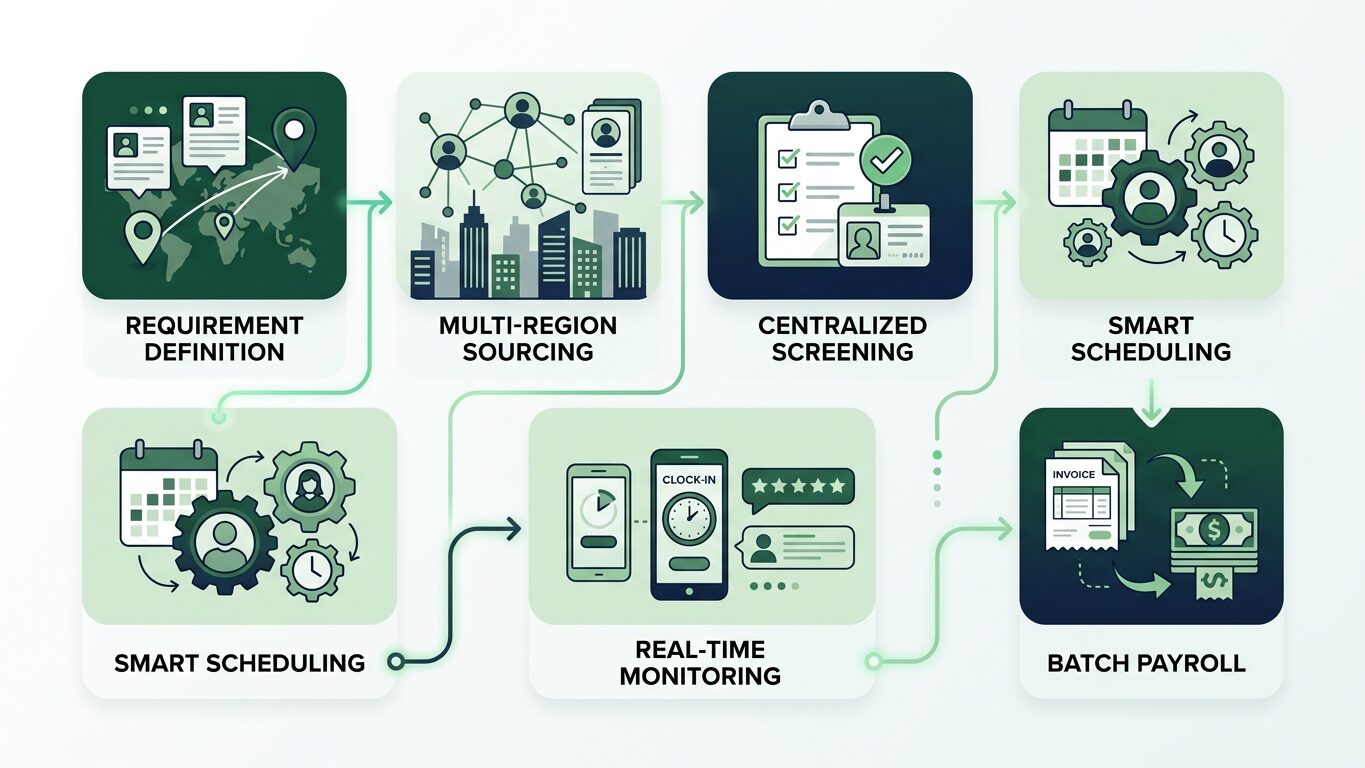
A workflow for agencies successfully managing multi-location temporary staffing requests and deployments.
Checklist for Multi-Location Temp Staffing Management
To ensure your agency is well-equipped for managing temporary staff across multiple client sites, consider the following:
- Centralise Worker Data: Implement a single system for worker profiles, skills, and compliance documentation.
- Digital Availability: Enable workers to update their availability easily and accurately via a dedicated portal.
- Streamline Shift Booking: Employ technology to efficiently match worker availability with client shift requests.
- Automate Communications: Utilise automated notifications for shift details, changes, and operational updates to workers and clients.
- Remote Timesheet Approvals: Implement digital timesheet submission and approval processes for all client locations.
- Comprehensive Compliance Tracking: Ensure all right-to-work checks and AWR details are consistently monitored and recorded across all placements.
- Enhanced Operational Visibility: Gain a real-time, consolidated overview of all shifts, fill rates, and worker performance across every site, reducing manual oversight.
Enhance Your Agency's Multi-Location Operations
Optimising your operational approach to temporary staffing across various client locations can significantly improve service delivery and simplify daily agency workflows. A connected platform, designed specifically for shift-based temporary staffing operations, provides the necessary tools to manage worker availability, streamline shift fulfilment, track compliance, and automate timesheet processes efficiently. Explore how integrated agency operations can support your complex client needs.
If your agency is seeking to streamline its multi-location temporary staffing, we can help. Join our waitlist for updates and early access to Youtemp's platform features, specifically designed to support agencies managing complex, distributed temporary workforces.
Ready to streamline your multi-location temporary staffing?
Join the Youtemp waitlist for updates and early access to a platform built for agencies managing complex, distributed temporary workforces.