Temporary vs. Permanent Recruitment: Key Operational Differences
Understanding the difference between temporary recruitment and permanent recruitment is crucial for agencies and employers managing staffing needs, encompassing diverse workflows, compliance, and worker engagement.
usman ahmed
Updated 9 July 2026

Key takeaway
The fundamental distinction between temporary and permanent recruitment fundamentally changes operational workflows, compliance responsibilities (like AWR and right-to-work), and financial management, demanding tailored approaches for agencies and employers.
Choosing between temporary and permanent staff shapes an organisation's operational structure, compliance obligations, and how agencies manage their talent pool. It's not just about job duration; it dictates entirely different management approaches. This guide focuses on the critical difference between temporary recruitment and permanent hiring from a practical UK B2B perspective, highlighting how these fundamental distinctions impact daily agency and employer operations.
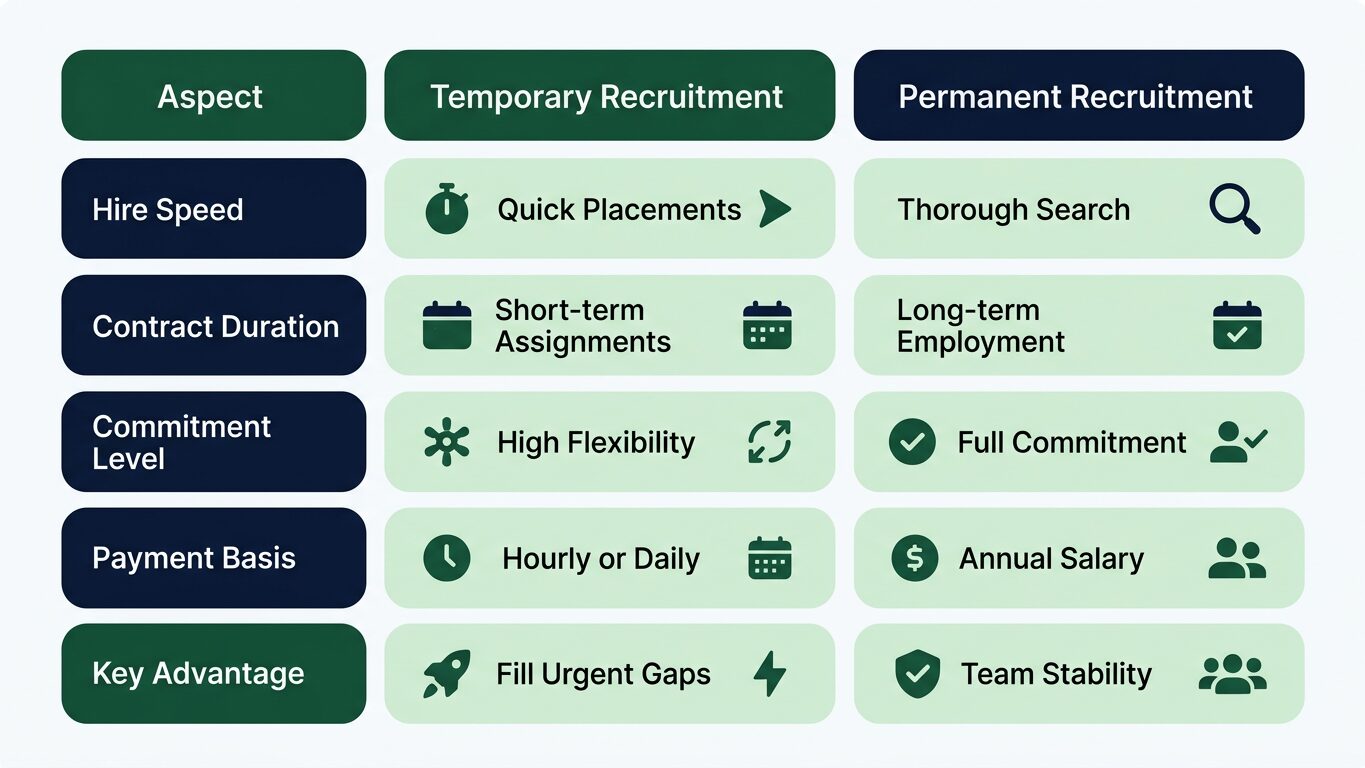
A concise overview highlighting the core distinctions between temporary and permanent recruitment from an operational perspective.
The Fundamental Difference Between Temporary Recruitment and Permanent Hires
At its core, temporary recruitment involves the fast deployment of workers for specific shifts, projects, or to cover absence, often facilitated by a staffing agency. Permanent recruitment, in contrast, secures individuals for an ongoing, direct employment relationship within a company. The key distinction lies in the commitment level and flexibility required: temporary staffing offers agility for fluctuating demand, while permanent roles represent a long-term investment in an organisation’s core workforce. For agencies, this means managing a dynamic pool of available talent, skilled in rapid deployment for urgent shift requests. For employers, permanent hires involve a more protracted selection process focused on cultural fit and career progression.
Operational Workflows: Rapid Shift Fulfilment vs. Structured Onboarding
The most visible operational difference between temporary recruitment and permanent hiring is in the workflow. Temporary staffing agencies manage continuous, often unpredictable, cycles of shift requests, worker availability updates, and immediate placements. For instance, a care agency might receive a client request on Monday morning for an overnight shift starting Tuesday. Their system must quickly identify suitable, available, and compliant workers, send out shift offers, track acceptances, and handle confirmations – all within hours. Effective temporary staffing relies on tools that provide real-time operational visibility, allowing agencies to monitor fill rates, manage no-shows, and ensure workers arrive prepared. A failure to fill this urgent shift affects both client service and the agency's reputation.
Permanent recruitment, however, follows a more conventional, extended process: detailed job descriptions, multi-stage interviews, comprehensive background checks, and then a thorough onboarding programme that can span weeks. The focus is on embedding the new hire culturally and professionally, not on immediate deployment into a shift.
Navigating Compliance: Right-to-Work, AWR, and Document Management
Compliance requirements for temporary and permanent staff also diverge significantly. For temporary workers, staffing agencies typically hold the primary responsibility for conducting and maintaining a spectrum of checks, including current Home Office right-to-work evidence, DBS checks where applicable, and professional qualifications. Crucially, agencies must also manage compliance with the Agency Workers Regulations (AWR).
Under AWR, after 12 continuous weeks in the same role with the same hirer, temporary workers are entitled to the same basic working and employment conditions as comparable permanent staff. This includes pay, holiday entitlement, and working hours. Agencies must track these 12-week qualifying periods precisely for hundreds, if not thousands, of workers across multiple client sites. A system that automates tracking and alerts for AWR milestones is essential to avoid non-compliance. For example, if a temporary warehouse operative starts an assignment, the agency needs to ensure all their right-to-work documents are current and track their 12-week AWR period to adjust pay and benefits accordingly. Employers hiring permanent staff also conduct initial compliance checks, but the ongoing AWR management is not a factor.
Financial Management: Continuous Timesheets and Payroll Preparation
The financial operations for temporary and permanent recruitment are distinct. Temporary staffing relies on meticulous timesheet management, which directly impacts worker pay and client invoicing. Agencies must collect, verify, and process timesheets from numerous workers, often with varying pay rates, across different clients. This demands efficient client approval workflows, frequently through an employer portal, to ensure timely and accurate payments. For instance, an agency supplying catering staff for a large event needs to rapidly reconcile dozens of individual timesheets against shift bookings, account for any late changes, and ensure client sign-off before payroll can be run and an invoice generated.
Permanent staff financial management is generally more predictable. It involves fixed salaries and a regular monthly payroll cycle, managed internally by the hiring company's finance department. The high volume and variable nature of temporary worker timesheets mean agencies face a continuous, complex payroll preparation task, managing holiday pay accruals, pension contributions, and P45s/P60s for a transient workforce. Discrepancies can quickly lead to pay disputes, underscoring the need for robust operational procedures and dedicated software.
Worker Engagement and Agency Relationships
How workers engage with their roles and their associated organisations also varies. Temporary workers often value flexibility and the opportunity to gain diverse experience, frequently registering with multiple agencies. Agencies must cultivate strong relationships with their talent pool, providing clear communication regarding shift matching, payments, and future opportunities. Tools that allow workers to set their availability via a worker portal are key to this relationship.
Permanent employees typically commit to one employer, with the company investing in long-term career development and benefits. The engagement model here focuses on fostering loyalty and internal talent progression. Agencies, therefore, adapt their approach to be a supportive and efficient conduit for temporary workers, understanding their transient nature and varying professional goals.
Practical Staffing Considerations Checklist
For effective temporary recruitment management, agencies should consider the following operational points:
- Worker Pool Management: Is your database of temporary workers up-to-date with current skills, availability, and contact details, ready for rapid deployment?
- Shift Fulfilment Efficiency: Can you swiftly match available and compliant workers to client shift requests, track offers, and manage acceptances and rejections effectively?
- Compliance Tracking & Audit: Do you have an automated system to monitor current right-to-work status, DBS expiry dates, and AWR qualifying periods for all active temporary workers, maintaining a clear audit trail?
- Timesheet & Payroll Automation: Are timesheet submissions, client approvals, and the subsequent payroll preparation streamlined to minimise manual errors and expedite payments?
- Transparent Communication: Are there clear, efficient channels to communicate urgent shifts, late cancellations, and critical updates directly to temporary workers?
- Operational Reporting & Metrics: Can you readily access data on fill rates, no-shows, worker retention, and shift volumes to identify trends and continuously improve service delivery?
Understanding these operational and compliance differences is fundamental to successful staffing. Whether you're an agency optimising your temp desk or an employer balancing your workforce needs, the right processes and tools are essential. Youtemp provides a connected workflow to manage shift-based temporary staffing operations, offering comprehensive visibility and efficiency. If you are looking to streamline your temporary recruitment processes, consider joining our waitlist for early access.
Streamline Your Temporary Staffing Operations
Youtemp provides the unified workflow you need to manage shifts, compliance, and timesheets efficiently. Get early access to improve your temporary recruitment processes.