Why UK Employers Use Temporary Workers for Flexibility and Growth
UK employers use temporary workers for crucial operational flexibility, covering workload fluctuations, skill gaps, and seasonal demands without the long-term commitments of permanent hires.
usman ahmed

Key takeaway
Engaging temporary workers provides UK employers with essential operational flexibility to scale staffing levels efficiently and access specialised skills, directly impacting productivity and cost control.
Engaging temporary workers allows UK employers to precisely balance workforce capacity with demand, a strategic approach distinct from relying solely on permanent hires. This method ensures continuous operation and resource efficiency. It is a calculated decision based on specific operational needs, providing agility in a varied economic landscape.
Meeting Fluctuating Demand with Temporary Workers
One of the primary reasons UK employers use temporary workers is to manage fluctuating demand effectively. Businesses frequently encounter peak periods, seasonal rushes, or unexpected project requirements that strain their established permanent workforce. For example, a logistics distribution centre will experience a significant surge in demand during the Black Friday and Christmas shopping periods, requiring a substantial increase in picking and packing staff. Similarly, a hospitality venue might need extra bar and waiting staff for summer events or specific large bookings. Instead of permanently over-staffing for these irregular peaks, temporary workers offer a flexible solution, allowing employers to scale their workforce up or down efficiently. This direct alignment of staffing levels with current operational needs avoids unnecessary labour costs during quieter times and maintains service delivery standards when demand is high.
Bridging Skill Gaps and Specialist Project Needs
Temporary workers are frequently engaged to fill specific skill gaps or to contribute to specialist projects for a defined duration. A manufacturing firm might require a temporary CAD specialist for six months to design a new product line, or a local council might need an experienced social worker to clear a backlog of cases following a recruitment freeze. In these scenarios, hiring a permanent staff member would be disproportionate to the project's finite duration or the niche nature of the skill required. Temporary workers bring immediate, targeted expertise without the extensive recruitment process or long-term commitment. This approach is particularly valuable in sectors where technical skills evolve rapidly or for project-based work that does not warrant a permanent role.
Covering Absence and Operational Continuity
Maintaining operational continuity is critical for UK employers, and temporary workers play a key role in achieving this, particularly when covering planned or unplanned staff absences. Whether it is sick leave, maternity/paternity leave, or extended holidays, having qualified temporary cover ensures that essential tasks continue without interruption. For instance, a residential care home relies on consistent staffing levels to meet regulatory compliance and deliver quality care; a temporary healthcare assistant can step in to cover shifts, including at short notice, allowing proper patient management and care continuity. This approach reduces pressure on existing permanent staff, helps prevent burnout, and ensures that service delivery standards are upheld, minimising disruption to clients or customers. Agencies utilise platforms like Youtemp to manage worker availability and quickly match appropriate individuals to cover these needs, often tracking worker compliance documents including right-to-work evidence.
Cost Efficiency and Reduced Long-Term Commitments
The financial aspects are a significant driver for using temporary workers. Employers can avoid many of the overheads associated with permanent employment, such as specific recruitment fees, permanent benefits packages, ongoing training costs beyond the immediate role, and potential redundancy payments. While agencies charge a fee for their services, the overall flexibility and reduced long-term commitment often prove more economical for certain business models and project durations. This is especially relevant for SMEs or start-ups that need to control staffing costs tightly as they grow, allowing them to test new roles or expand operations with reduced upfront investment or risk. Employers can gain visibility into spend through dedicated employer portals that track temporary worker usage and associated costs.
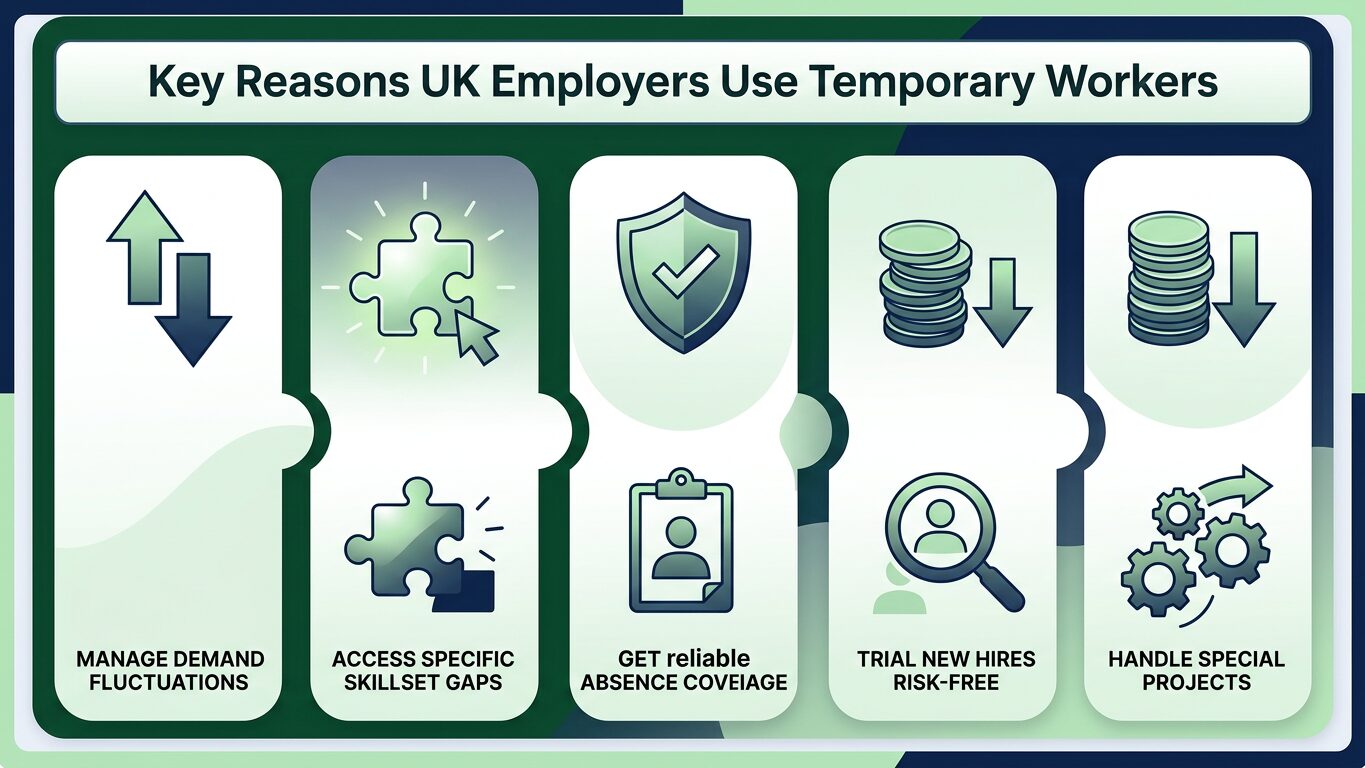
Key motivators driving UK employers to utilise temporary workers for their business needs.
Assessing Fit Before Permanent Hire
For some UK employers, temporary assignments serve as an extended interview or a 'try-before-you-buy' period. By bringing in a temporary worker, they can assess a candidate's skills, work ethic, reliability, and cultural fit within the team without the immediate commitment of a permanent contract. If the worker performs well and a permanent need subsequently arises, they might be offered a full-time position. This reduces the inherent risk associated with permanent hiring decisions and provides both the employer and the worker with an opportunity to ensure a suitable, long-term match. This process often involves reviewing timesheets and worker feedback, which can be streamlined via platforms that offer shift management tools.
Practical Staffing Examples
Consider these common scenarios where temporary workers prove essential in maintaining operational efficiency:
- Emergency Response: A local authority's street cleaning department faces an unexpected increase in fly-tipping incidents. They rapidly engage several temporary workers to address the clean-up, managing shift patterns and operational areas efficiently through agency requests, preventing a backlog and maintaining public standards.
- Event Staffing: A large-scale music festival requires hundreds of specialist temporary staff, including security, medical support, and accreditation processing. These roles are for a short, intense period, and engaging temporary workers ensures the event runs safely and smoothly without the burden of hiring permanent staff for a few days a year.
- Construction Project Surge: A construction firm wins a new contract requiring an immediate ramp-up of specific trades, such as steel fixers or electricians, for a 9-month build phase. They use specialist agencies to source these temporary workers, ensuring all relevant certifications and right-to-work documentation are confirmed before placement.
Checklist for Engaging Temporary Workers Effectively
Effective engagement of temporary workers requires clear processes and good communication to maximise their value:
- Clearly Define Needs: Outline the specific tasks, required skills, duration, and shift patterns for each temporary role before making a request.
- Verify Agency Compliance: Ensure your chosen agency explicitly declares adherence to all relevant legislation, including right-to-work checks, AWR (Agency Workers Regulations), and proper payroll preparation.
- Streamline Onboarding: Provide concise, relevant information, site induction, and necessary equipment for temporary staff to be productive quickly from their first shift.
- Establish Feedback Channels: Implement a method for providing and receiving performance feedback on temporary workers to ensure continuous improvement and aid re-bookings.
- Utilise Operational Tools: Employ integrated platforms for shift planning, timesheet approvals, and reporting to maintain clear visibility and control over temporary staffing usage and spend.
- Maintain Clear Communication: Keep open lines of communication with both the temporary worker and the supplying agency regarding shift changes, performance, or any operational concerns.
UK employers frequently turn to temporary staffing as a deliberate operational strategy to navigate the challenges of modern business. It provides a distinct advantage for managing unpredictable workloads, accessing specialised skills, and maintaining cost-effective staffing models, especially as businesses increasingly seek efficient ways to coordinate their contingent workforce. Employers should ensure they have clear audit trails for all temporary worker engagement.
If you're an employer looking to streamline your temporary staffing operations with integrated shift management and worker compliance, join our waiting list to see how Youtemp can help. Join the Youtemp waitlist
Streamline Your Temporary Staffing Operations
See how Youtemp can help you manage your contingent workforce with greater efficiency and control. Join our waitlist for early access.